
March 2026 Bonsai "Growing Tips" Column
Seasonal bonsai musings from Colin
Colin Fraser Purcell
3/17/20263 min read

Some Late Repotting and Plenty of Pruning
Spring officially begins on March 20th but warm weather is here already! That means a lot of us are rushing to get any remaining repotting done before it heats up further, and lots of trees are already into a vigorous growth spurt. Here’s a look at what I’m working on this month, and some tips you can apply to your trees at home . . .
Late Repotting: Well, as I said in last month’s column, I like to see a couple of weeks of cooler humid weather after repotting temperate species, but that’s definitely not what’s happening now. When we cut and/or damage roots during repotting, it takes time for new root hairs to grow and water uptake capacity to rebound. In the interim, I can’t force more water into the tree, but I can mitigate water loss with shade and higher humidity. A shade-house, greenhouse, or shady spot under a big tree is a great place to keep fresh repots for a couple of weeks while they recover.
Some deciduous trees need a lot of water to inflate new leaves in the spring. In our climate, if roots are cut after delicate new leaves have emerged, some wilting is to be expected. This is why I prefer to repot deciduous trees just before the buds open, but sometimes a late repot can’t be avoided. When repotting a bonsai with soft new leaves, I’ll often cut it back hard first. This reduces its water needs, and sort of re-sets the spring growth, making it less likely to wilt or die back.
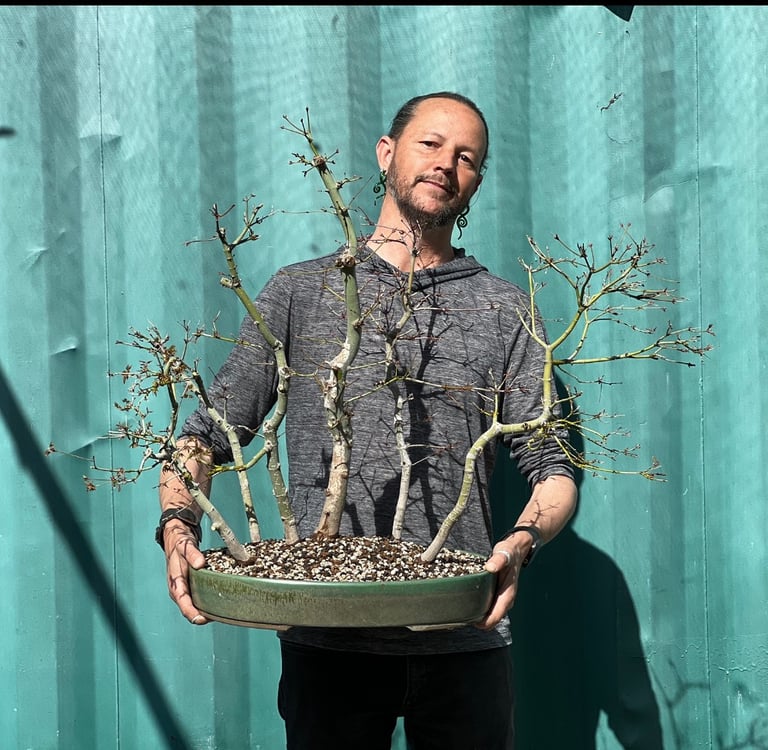
Deciduous Trees: Speaking of delicate new leaves, my Maple, Crape Myrtle, Liquidambar, and even Ginkgo bonsai are either pushing now or already leafed out. Any trees that haven’t already been “edited” are getting a trim so that new growth can remain closer in, rather than wasting all that spring vigor on the distal tips of overgrown branches. Some of my Chinese Elms have been trimmed two or three times already!
For a vigorous bonsai in a fairly refined state I like to cut the extending shoots as soon as couple of nodes are visible. This helps to keep internodes shorter and build ramification. Beware of cutting weak trees before new growth has had a chance to harden off and “pay back” the energy it took to grow.
You’ve probably heard the common advice to cut back to the first two leaves when pruning broadleaf trees, and that’s a pretty good place to start, but there are times when leaving more might be a good idea. With tiny leafed cultivars like ‘Seiju’ or ‘Hokkaido’ Elms, the internodes are so short that there isn’t really an issue with allowing them to extend and harden off before pruning. These should be cut to what looks good, rather than adhering to a strict rule of 2.
Fertilizing: When I ask students if they’ve been fertilizing their bonsai, I often feel like a dentist asking patients if they’ve been flossing everyday — in both cases, most people give a sheepish “not as much as I should” kind of answer. If you haven’t started fertilizing already, you definitely should, especially if your trees are in inorganic soil. Akadama/Pumice/Lava mixes are basically devoid of nutrients, so it’s completely up to us to supply all of the Nitrogen, Phosphorous, and Potassium our bonsai need. I prefer organic fertilizers for refined trees in bonsai pots with this kind of soil. Look for single digit numbers for the N-P-K (e.g. 5-5-5). Mild slow release cakes or pellets allow continuous fertilizing without danger of overdoing it and burning the tree. Replace cakes every six to eight weeks as they decompose. For prebonsai in organic soil and nursery pots, I am happy to use chemical fertilizers, as the risk of damage is much less. Any kind of fertilizer can be fine for most trees, as long as you know how to use it properly; even concentrated high-nitrogen fertilizers can be diluted to mild levels with a little work, but I recommend beginners stick with mild organics to avoid mishaps.
One final note about Black Pines: start early and fertilize heavily in the spring. By summer we will be removing candles and then withholding nitrogen for a while, so this is your chance to get them really ramped up and strong for the year.
I hope you all have a wonderful spring, and for those of you that celebrate, Happy St. Patrick’s Day! I’ll be raising a pint in toast to you and your wee trees.